Silly Goose
Hunkered in the bulrushes that late-April morning, I’m struck by a notion that the marsh around me is a living organism. The place fairly vibrates with motion and sound and, along with the several species of ducks paddling, dabbling, and splashing in my viewfinder, I’ve come to take part in its heartbeat. Such cameos, minuscule and itinerant as they are in nature’s scheme, go a long way toward feeding and warming a wildlife photographer’s soul.
With camera on silent shutter, I spend the first half hour after dawn focused on green-winged teal, northern shoveler, a lone pintail. Then, a gadwall pair paddles into a tiny cove across from me. Particularly handsome in its gray-tweed plumage, the drake captures my attention for nearly an hour. Overhead, mallards soar in courtship flights as drakes pursue and mob the odd single hen.
Eventually, I turn beyond the reeds to an expanse of unbroken water where diving ducks feed. Occasional snowflakes cut whirling paths through the scene as bachelor parties of Barrow’s and common goldeneye drakes mingle with scaup pairs. In the foreground, three or four buffleheads alternately pop into and out of view, shaking their heads before diving again.
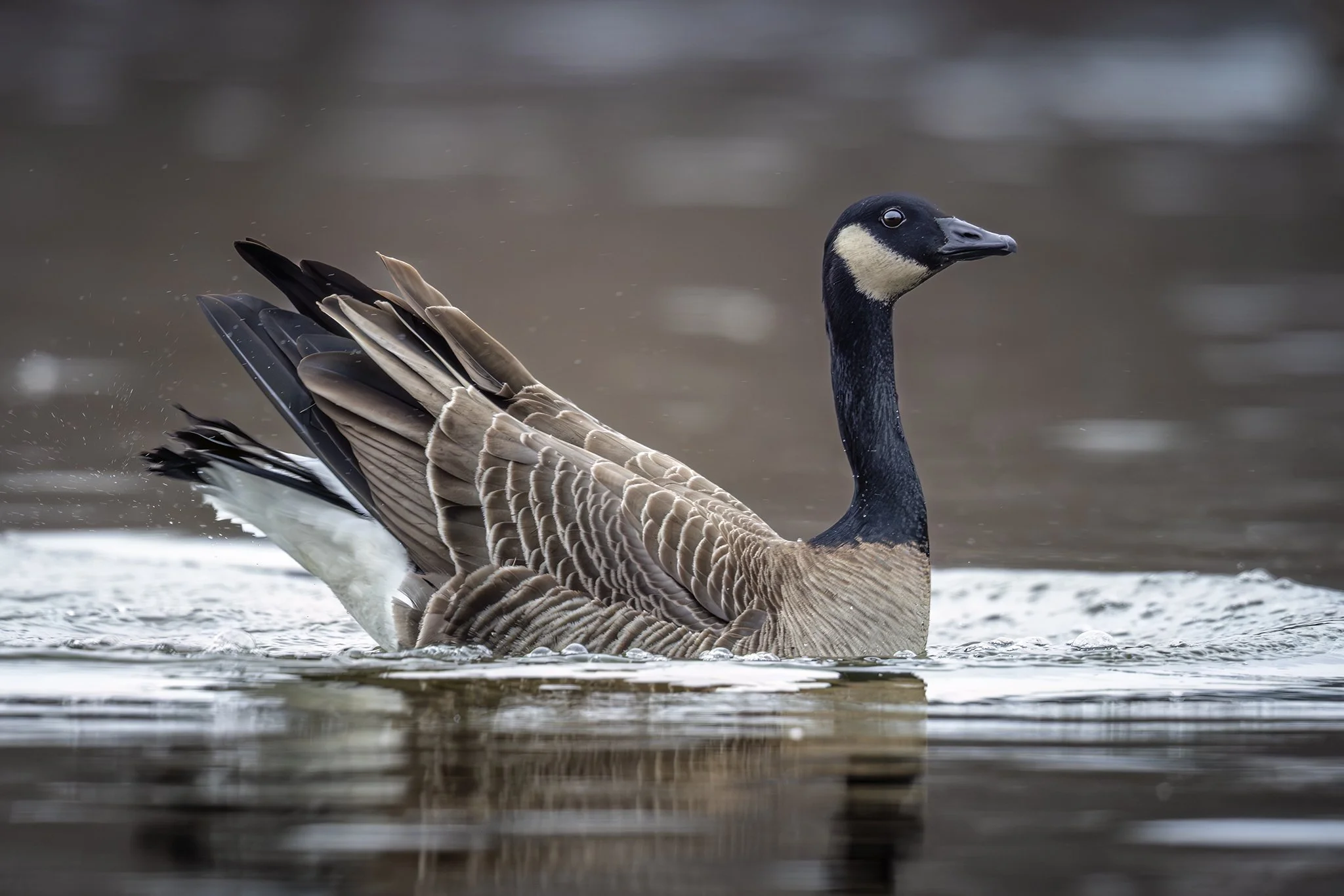
I’m tracking a white-hooded bufflehead drake, taken by the iridescent purples, blues, and greens of its cheeks and neck, when a loud, brassy honk startles me like a cattle prod. Abruptly, a Canada goose drops out of the sky and splashes down before me. There the bird settles in, ruffling its wings and assuming a prissy posture, neck perpendicular to the water, its imploring eye, head, and bill tipped up slightly.
I recognize the bird as a cackling goose, one of the smallest Canada goose subspecies—mallard-sized at most, and often mistaken for its larger cousins. North America is home to at least 11 Canada goose subspecies and in 2004, ornithologists designated the smallest four subspecies cackling geese. The smallest “cacklers,” as many call them, are roughly mallard-sized, which makes the bird before me one of the larger cackling goose varieties.
Of course, Canada geese of one species or another are ubiquitous to North America. The birds are so common that few wildlife photographers bother shooting them. I mean, what’s interesting about something we’ve seen a thousand times plucking grass from and heavily “fertilizing” golf course fairways, schoolyards, or city parks?
Still, I feel compelled to shoot this silly goose. I don’t know exactly why. Something in the bird’s posture and its judgmental 19th century schoolmarm expression seem to break through the cold morning light and speak to me. And as an image, the thing still mutters to me—transporting me back to the pulse of the place, the season, the very moment captured. I can look at this picture and feel the morning’s cold air, hear the quacks, chuckles, and wingbeats around me.
That time-machine element, that reconnection to nature, may not transcend to others. But as much as anything else, it goes a long way toward defining for me the appeal in photographing all things feathered, furred and beyond.