UNFORGIVEN
Far behind me, in the civilized world, I’d been struck by events only time
and distance could mend.
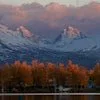
Most striking were the mountains. Stacked across the ages by tectonic forces, sculpted by Cambrian seas and the advance and retreat of Pleistocene ice, limestone spires shot up around me, reaching through a fog for the sun, moon, and stars.
The date, August 1, 1989, marked my first steps into the Brooks Range and the one time I might truly claim to have stood at the top of the world. Dropped off by Bush plane on a high saddle far north of the Arctic Circle, I spent that first evening straddling the Arctic Divide. To the north the mountains fell into a vast, treeless tundra that flowed beyond the horizon to the Arctic Ocean, home to pack-ice, whales, polar bears, and parka-clad Inupiat. Over my shoulder to the south, sharp peaks tumbled into Alaska’s wild Interior, a largely forested, fabled province of fur trappers, gold fever, black bears, and Athabascan hunters.
I absorbed it all: the colors, the coolness, the high, thin air. I was young then and the planet fresh and so intensely beautiful. I was learning, too, that it can be a tragic place. Far behind me, in the civilized world, I’d been struck by events only time and distance could mend. So I’d entered that wilderness where a young man might release his heart to the hills, streams, and empty skies to forget what cannot be forgiven.
That first night on the divide would be followed by an eight-day journey through trackless country, so next morning I shouldered my backpack, turned south toward the headwaters of the Koyukuk River, and vanished into a clean, new world where the past didn’t matter.
Initially, I was drawn to this place, the Gates of the Arctic National Park and Preserve, by the writings of Robert Marshall, author of Alaska Wilderness and founder of The Wilderness Society. An explorer masquerading as a forester, Marshall first traveled from his New York State home in 1929 to this then-uncharted country. Here, he followed rivers and climbed mountains, gave names to them – and eventually this national park – and shared his discoveries and insights in lyrical accounts.
Sixty years after Marshall’s first visit I picked my way down through a precipitous gorge at the Koyukuk’s head, then over tundra where caribou antlers dropped in previous winters lay bone-white and scattered on the moss. Through a fine mist I watched seven Dall sheep feed on a mountainside; a sunbeam pierced the clouds and found them, lighting the tundra and framing the scene with a brilliant rainbow. Later, a black wolf sitting on its haunches, pink tongue lolling, watched me from a hillside nearby.
At Bombardment Creek, my bush pilot threaded a tight, rocky gravel bar to land and drop off a raft that would allow me to ride the river to tiny Evansville. And after days of rain, wind and, finally, a stretch of intense subarctic sunshine, I passed between Boreal Mountain and Frigid Crags – the park’s “Gates of the Arctic” – and emerged with a new peace and confidence, still present in my best moments today.
###