Gulf Coast Secrets
Rumors of wild steelhead spur a trek into Alaska’s remote Gulf Coast to solve the riddle of a biologically uncharted stream.
We turn on the wing of pilot Steve Ranney’s Cessna, flying low and deliberately, like a mechanical eagle whose insides are living things that see and shout.
“There’s your river,” Ranney hollers. It’s beautiful, even through veils of wind-driven rain, a dream stream parting trackless wilderness unchanged since before the Mayflower, the Vikings. Even the Crucifixion.
Ranney circles for my benefit, allowing me to study the water and terrain. Our bird’s-eye view suggests high promise in the river’s dark pools and dashing runs. Reaching those unfished eddies, however, will be miserable. The river is set apart by a multi-tiered buffer of marsh, alder thicket, and forest. In its final leg, the channel joins the lower, tidal reaches of a larger river bordered by sand dunes and Alaska’s white-capped Gulf Coast.
To fish the smaller river, my target, I’ll need to walk from the dunes where I’ll be based to a shallow, brackish lake which I must cross. The crossing will require ginger wading to avoid deep drop-offs. After that, I’ll have to navigate nearly two miles of waist-deep bog. The final stretch will entail bushwhacking through a forest of hemlocks and clinging alders.
We drop into the dunes within two minutes, a trip that will take me at least that many hours on foot. A rough airstrip appears among sandhills two stories high and, soon, we bounce to a stop. For a moment, everything is still except for the wind and rain splattering the side of the plane.
Of course, I’m anxious on this late-April day, eager to fish in the wake of a long Alaska winter. Yet something else excites me even more; that river beyond the marsh and alders is an enigma. A state fisheries biologist told me some 50,000 coho salmon spawn there each September and three times that many are taken at its mouth by commercial gillnetters. Beyond that, though, the river is biologically uncharted. A great unknown.
Still, there have been rumors. A friend who once made his living netting salmon in the area once muttered that big sea-run trout sometimes appear in the commercial mesh. They’re quietly tossed in with the coho, he’d said, and sold by the pound. Steelhead. Everybody seemed to net a few.
At the moment, the fall coho rush is months away and the dunes, the gulf, and that river cutting through the middle of nowhere are deserted. No salmon, no people. In my duffel I’ve packed an 8-weight fly rod, a stout Lamson reel, and several boxes of flies. In my head a question throbs, and there will be no relief until I’ve attacked it head-on.
A stone’s throw from high tide, Ranney leads me to a plywood shack atop a dune. He uses a claw hammer to wrench nails from the weathered door and apologizes for the shack’s rusticity. Really, though, when the rains fall and the winds blow (actually, a friend familiar with the region once warned that the winds here never blow, they suck), a plywood shack—and this one comes complete with functional oil stove—becomes a castle. No apologies necessary.
I hauled my gear up from the plane—fly-rod tube, waders, a cardboard box of food—and Ranney (a name with a phonetically appropriate ring for a Gulf Coast pilot) is bending his six-foot, two-inch frame back into the Cessna. In a moment, he will roar off, out of the dunes, over the black, tossing sea. And for the next four days, I will be on my own.
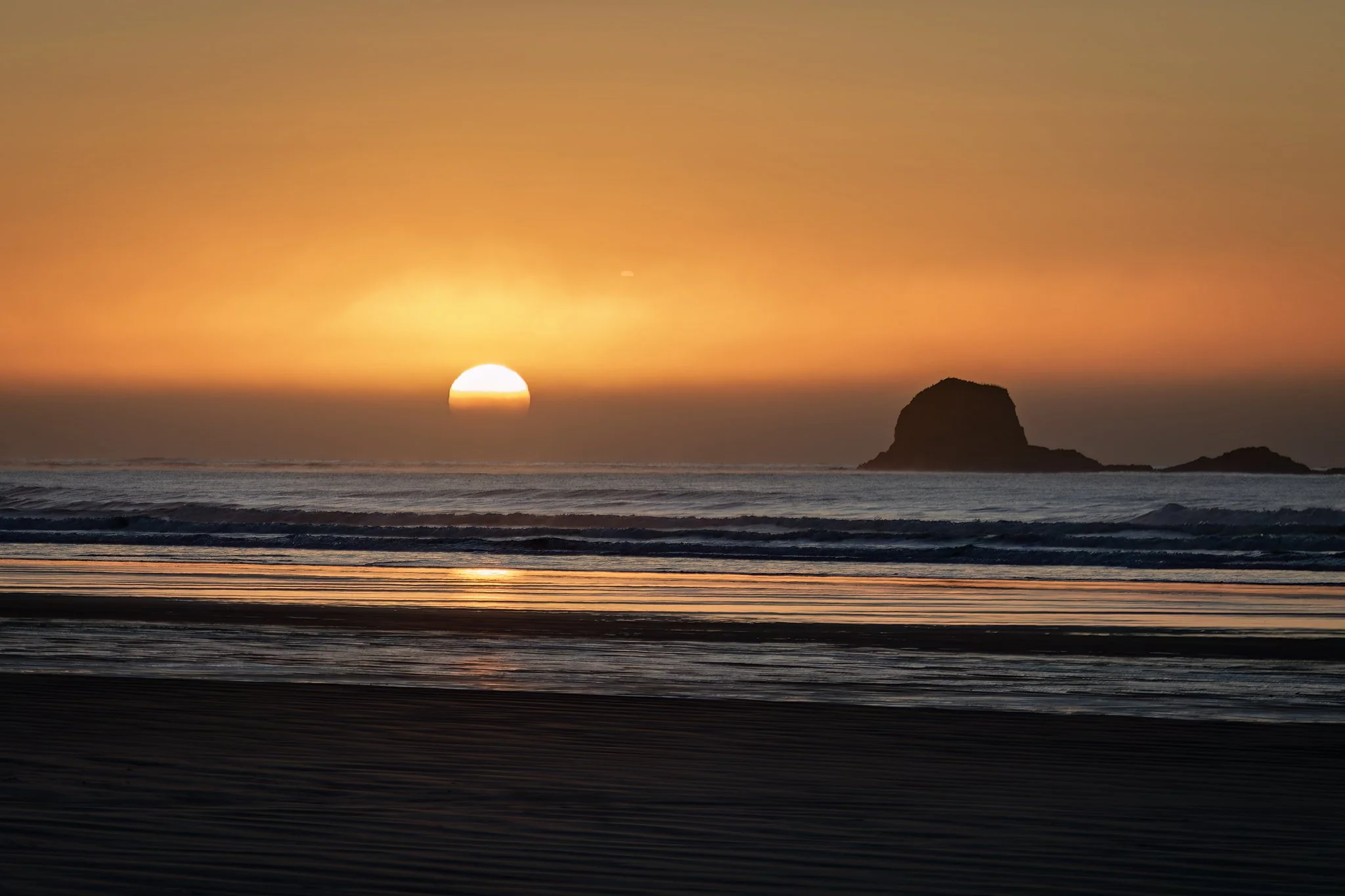
Alaska’s Gulf Coast is a wet, windy region; few corners of the world are more remote. Ocean squalls slam into glacier-hung mountains, and the winds often howl for weeks without pause. In contrast, on rare mild days in spring and summer, when the sun shines and the hemlocks dry out, it is a place of harebells, salmonberries, and creatures as delicate as thumb-sized rufous hummingbirds. The deltas of several great rivers provide avenues for salmon— awesome runs of sockeye, Chinook, and coho—and serve biannually as funnels for birds migrating by the millions. Yet more than all that, the Gulf Coast is wild, a place where unfished streams purl as unanswered questions, beyond the ken of biologists and anglers, through unspoiled valleys.
The surf advances with a drumroll that crescendos, peaks, then breaks and retreats in a carbonated hiss. It is late afternoon, and I am leaving Ranney’s shack, clad in waders and rain gear, fly rod in hand. I’m walking inland, through a steady rain, across the dunes. Here and there, canine prints wide as my hand can be seen crisply imprinted in the wet sand. Wolves.
I’d spotted several moose lying among the alders as we’d flown in. The moose are safe from wolves today since the winter snowpack that bound them, that left them floundering helplessly, has melted under April’s rains and temperate winds. The wolves have now moved out to the dunes where they can make their livings by the mouthful, snapping up voles and migrating birds.
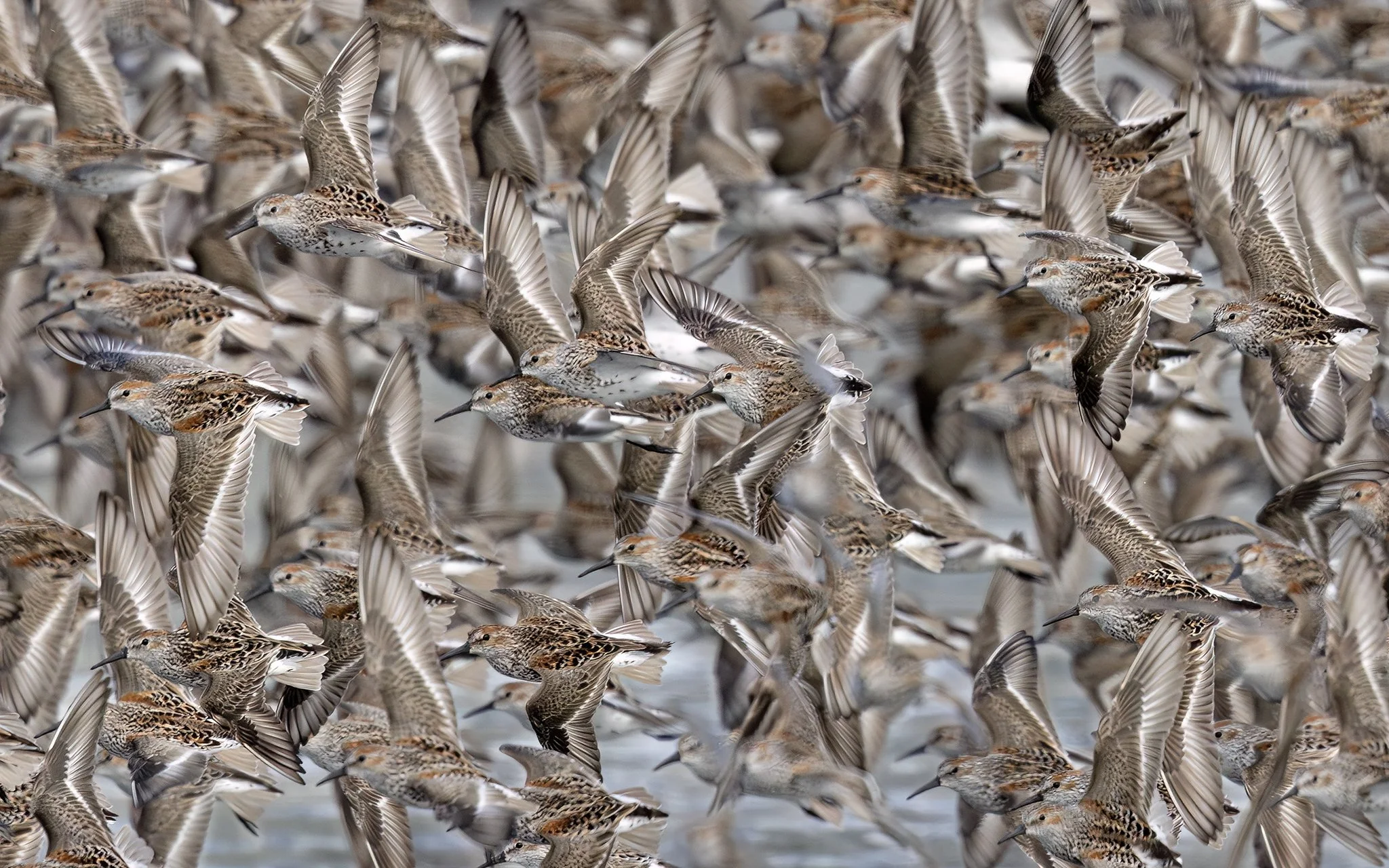
Within 20 minutes, the dunes dissolve into the shallow, mile-long lake, knee-deep, brackish, backed by the spongy bog I’d seen from the plane. Shorebirds storm the sky. Western sandpipers, dunlins, plovers, dowitchers, and others whistle overhead in great flocks, jinking in single-minded, mass unison. Sandhill cranes meander, circling and gliding high above, calling with cracking voices. Trumpeter swans honk, and geese of all kinds yelp in northbound gangs. From the bog, a stench that is rich, repulsive, sulfuric, stains the air; pintails, wigeons, shovelers, and teal in flocks of hundreds roar out of the stinking grass. The hiking now is slow, each step uncertain, painful for soft, winter-fat thighs.
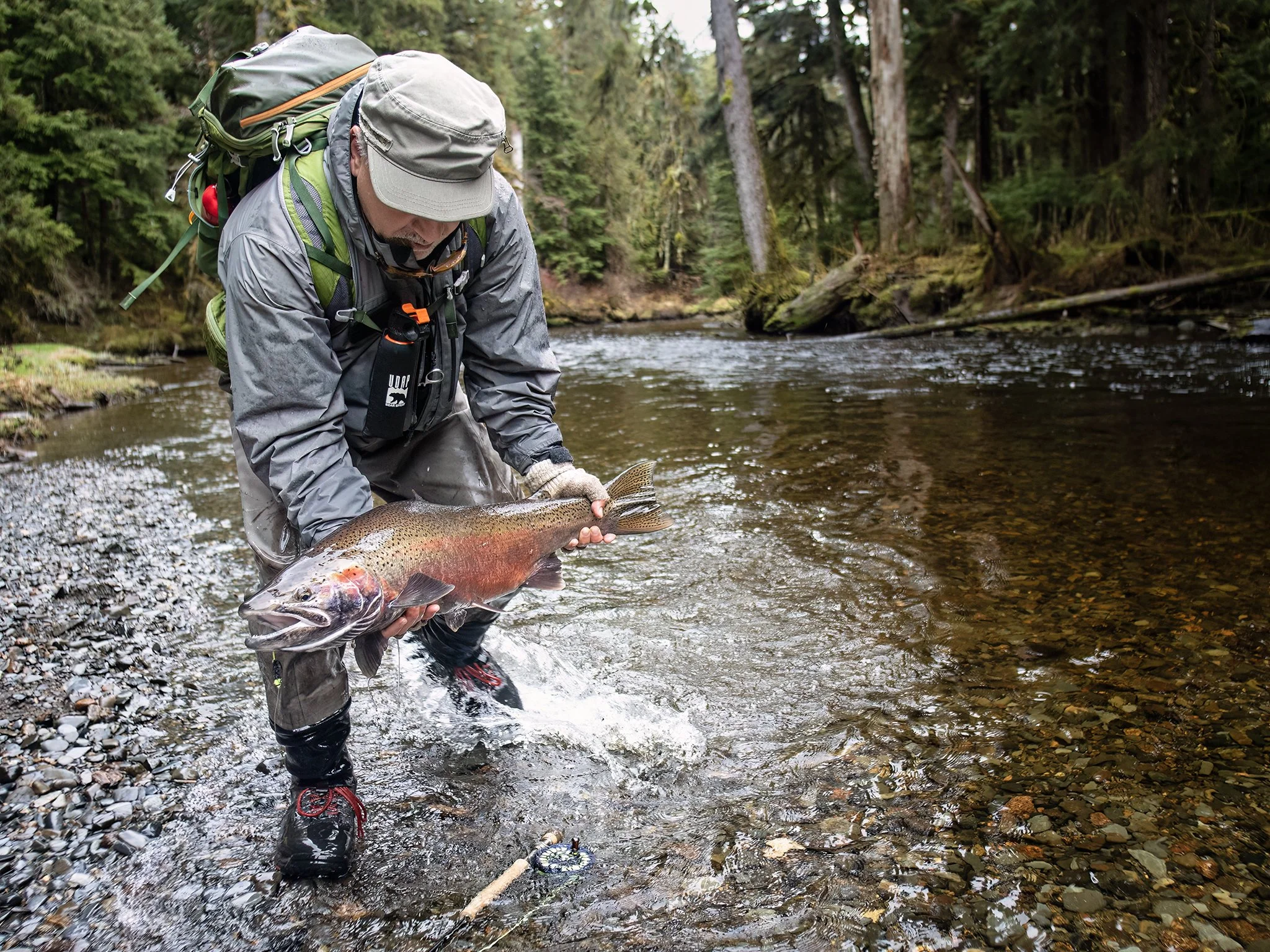
Steelhead are my obsession, my addiction, and like any junky, I’m at a loss to explain exactly why. They goad me when the weathers of spring and fall are at their rankest and, like a knight seeking his Holy Grail—or, perhaps, more like a fool—I’m driven to step out and answer their call. The appeal is complex, but simply put, everything that draws me to flyfishing can be found in chasing steelhead.
On reflection, my steelhead flyfishing proclivities seem rooted to basic instinct, impulses natural and true as the rising sun. I’m drawn by the stalk, the study, the questions, the possibility of success. The reward occurs when these elements all merge into one electric instant and the rod comes alive and line screams off my reel. A confession: Late at night, when I’m on my back and my body’s stopped twitching, I dream of these moments. Sometimes, after the take, a monster fish drags me into a swift, frothing river, and I awaken with a start.
Among sport fish, steelhead stand apart. They are powerful, like salmon, but not as common; they don’t come in perfectly minted, mass-produced droves to spawn once and die in rotting stacks. Instead, each fish is an individual, distinguished by color, size, and form, a struggling sliver of wildness and light.
Steelhead lead me to places that agree with my nature; to streams that are remote, unpolluted, and unpeopled. I've not mastered these sea-run trout and am often baffled by their fickleness. I find them frequently enough holding in shadowed, deeper runs, yet there’s never a guarantee I’ll coax one to strike. When I do hook a steelhead and pull it from the river, when I grip its writhing coldness, meet its iron glare, touch its metallic flanks, I feel the junky’s rush, euphoric, undeniable. I have counted coup, and all the work and misery of wind and rain, the many fishless hours, are compensated by a spiritual fullness.
Of course, in the end, it’s only a fix. The craving always returns.
Two hours later I’m still marching, in a driven drizzle, among tussocks and seeps, dead grass to my armpits. Steller’s jays, cobalt tails melding like winter nights into black, crested heads, scream in the brush. I pause for a moment to find my bearings. I can’t tell whether the trickles tracing my forehead and cheeks are products of rain or strain. My heart pounds. Close by, on the far side of a thicket, the river whispers.
For a moment, there among the sobbing alders, questions gnaw. What if I’ve come all this way for nothing? What if the steelhead are not here, have never been here? Yet hope is at the heart of this sport, where each cast is a question, a defiant probing for truth. Besides, here alone in the maw of Alaska’s coastal wilderness, there’s no turning back.
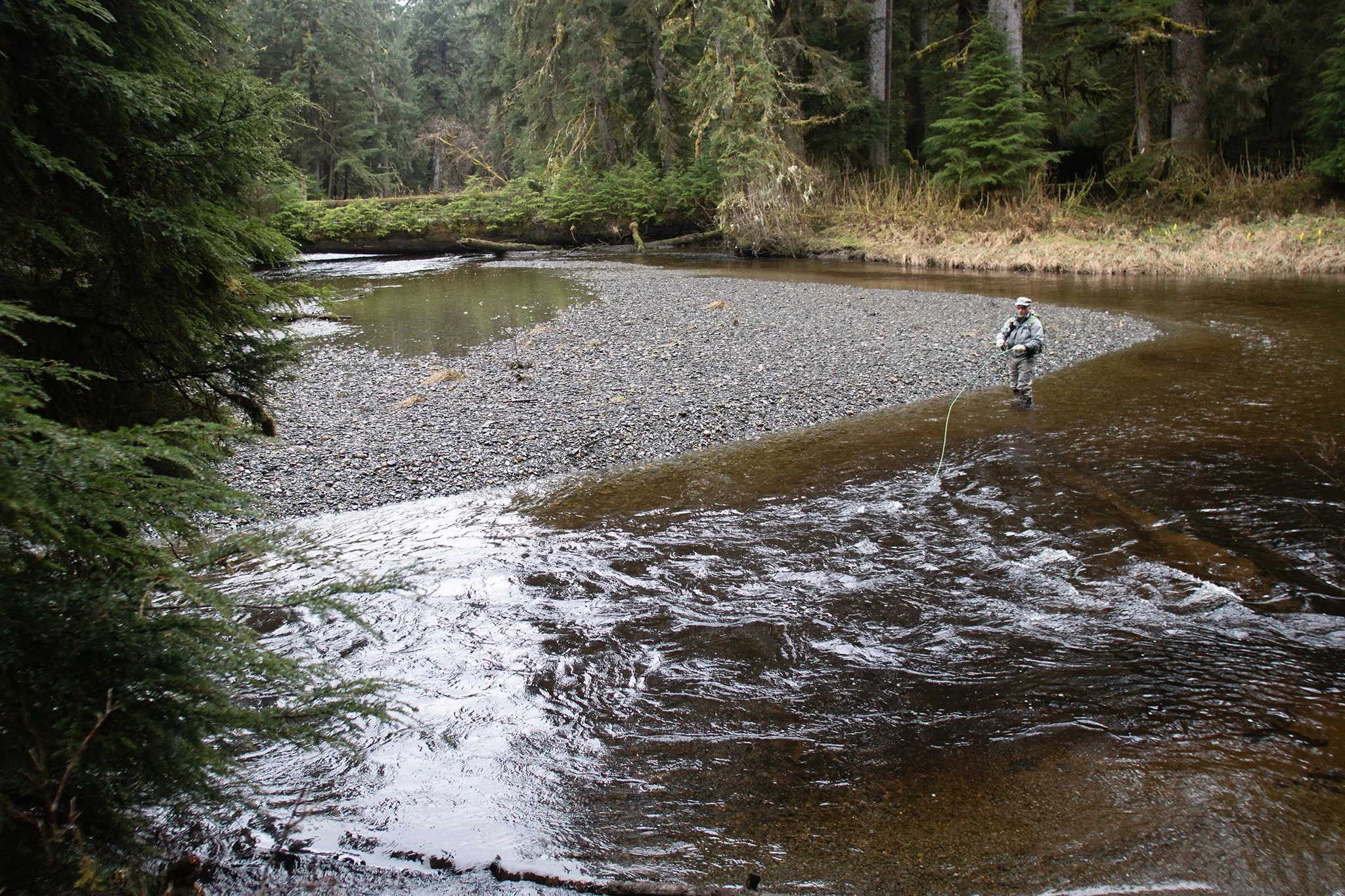
In a heartbeat I am at the river’s edge, unaware of the rain, focused on those tannic waters flowing through winter-killed grass and black alder. The stream runs two lanes wide, slow and smooth. The bottom is gravel, scalloped with deep convolutions that make wading tricky. A glare glazes the surface, leaving the water opaque and complicating things further; I might be casting into a pool eight-feet deep or onto a fishless, heel-deep bar.
On a whim, I’ve passed over the Purple Perils, Skykomish Sunrises, and Skunks, the dressings of tradition. Instead, I’ve chosen a “Green Screamer,” my own name for something new and rather garish: Flanked in sparkling strands of Mylar, it’s a rabbit-fur strip dyed a jarring chartreuse and wound over a weighted streamer hook. It’s a popular choice for king salmon fresh from the sea and I figure the habits of returning sea trout might not differ so from those of salmon. I have, however, downsized the pattern from king-sized #3/0 to #6. Anyway, the impetus of this trip is to crack mysteries and break molds. In a moment, I am casting.
Steelhead remind me of lovers: You always remember your first one. My first fish came on a dusky September evening that smelled of spruce pitch and Borax-cured salmon roe. I was fishing on the Kasilof River for late-run coho – meat fish for the freezer. I recall my shock at the strike, so sudden, explosive, escalating instantly into a frenzied run that ended seconds later with a 13-pound trout beaching itself in a wild leap.
I encountered them again one summer on Kodiak Island’s Karluk River while casting dry flies with a 5-weight in a hatch of green drakes. Mostly I caught Dolly Varden, 2-, 3- pounds apiece, but every third or fourth fish turned out to be a “half-pounder” steelhead. They weren’t mature, but they were steelhead, novelties that lent the episode a unique kick.
After that, a certain intrigue began to evolve. I stalked steelhead on winter visits to Haig-Brown’s Vancouver Island where I found them sulking darkly in the Stamp, Eve, and Cowichan rivers. I caught them on Alaska’s Kenai Peninsula in the famous Anchor River, where they grabbed dark streamers and tore downriver like hooked bulls. Intrigue welled into fever and somewhere along the line, I discovered that I’d grown serious about fly fishing for steelhead. All of which has led to this moment, this curious Gulf Coast quest. For an hour there are no signs. Just the gentle river simmering in a steady rain, and peeping birds – juncos, sparrows, kinglets, and so many nondescript little brown warblers and whistlers that I can’t keep track of them all. Then, at the edge of a drop-off marked by faint riffles, a fish tails. I see the squared caudal cut the surface, wag softly, and with a forceful sweep, disappear. I cast a streamer above the drop-off and watch it dissolve into the deep water.
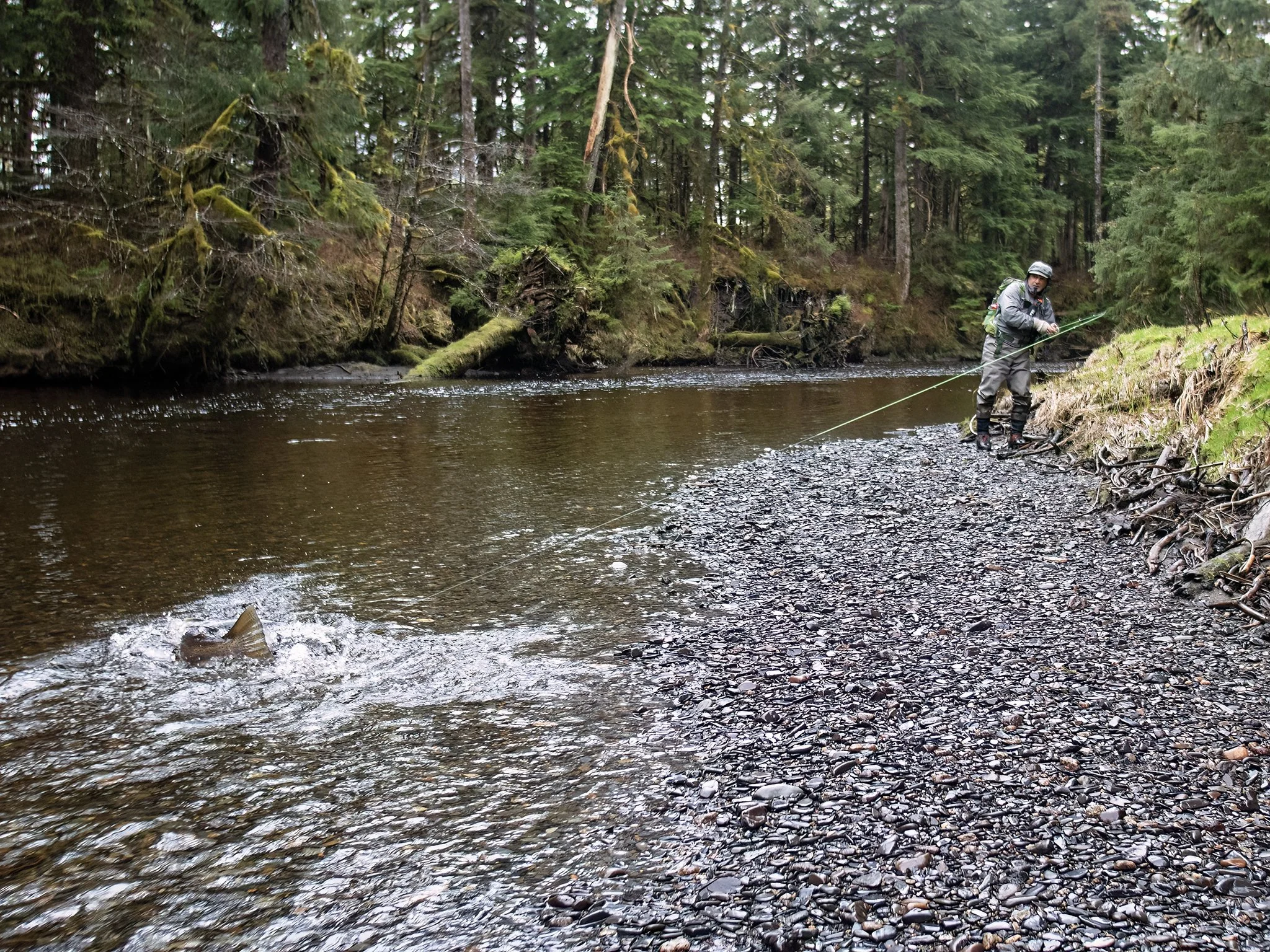
The take is slight, dainty, an almost imperceptible contradiction to the current’s steady flow. I haul back, drive the hook into something solid. The fish leaps madly once, twice—at least six times—tumbling in the wet air, landing with loud slaps like a heavy, animated plank. There are several downstream runs and for a moment I am perfectly bound by the energy to which I am connected with a weight-forward floating line and pulsing graphite rod.
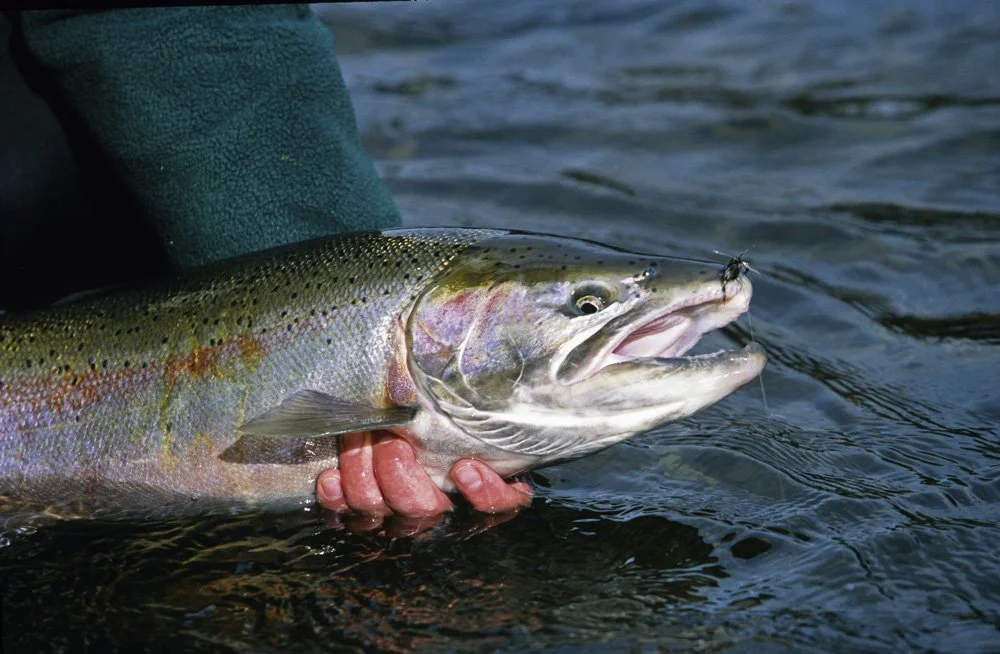
The runs eventually grow weaker and my world, once spinning out of control, begins to slow. Sometimes, when a great fish plays out, the feeling is like stepping off a thrill ride; time, frozen in the course of the struggle, resumes suddenly in measurable form. My hands tremble when the fish, a steelhead hen weighing perhaps 10 pounds, turns on its side, allowing me to draw it in and pull the hook. I lower it into the current where the fish hovers briefly, bright as sunshine on polished chrome. The shroud of mystery, so distinct and heavy an hour ago, has slipped silently away. I blink and the fish is gone.
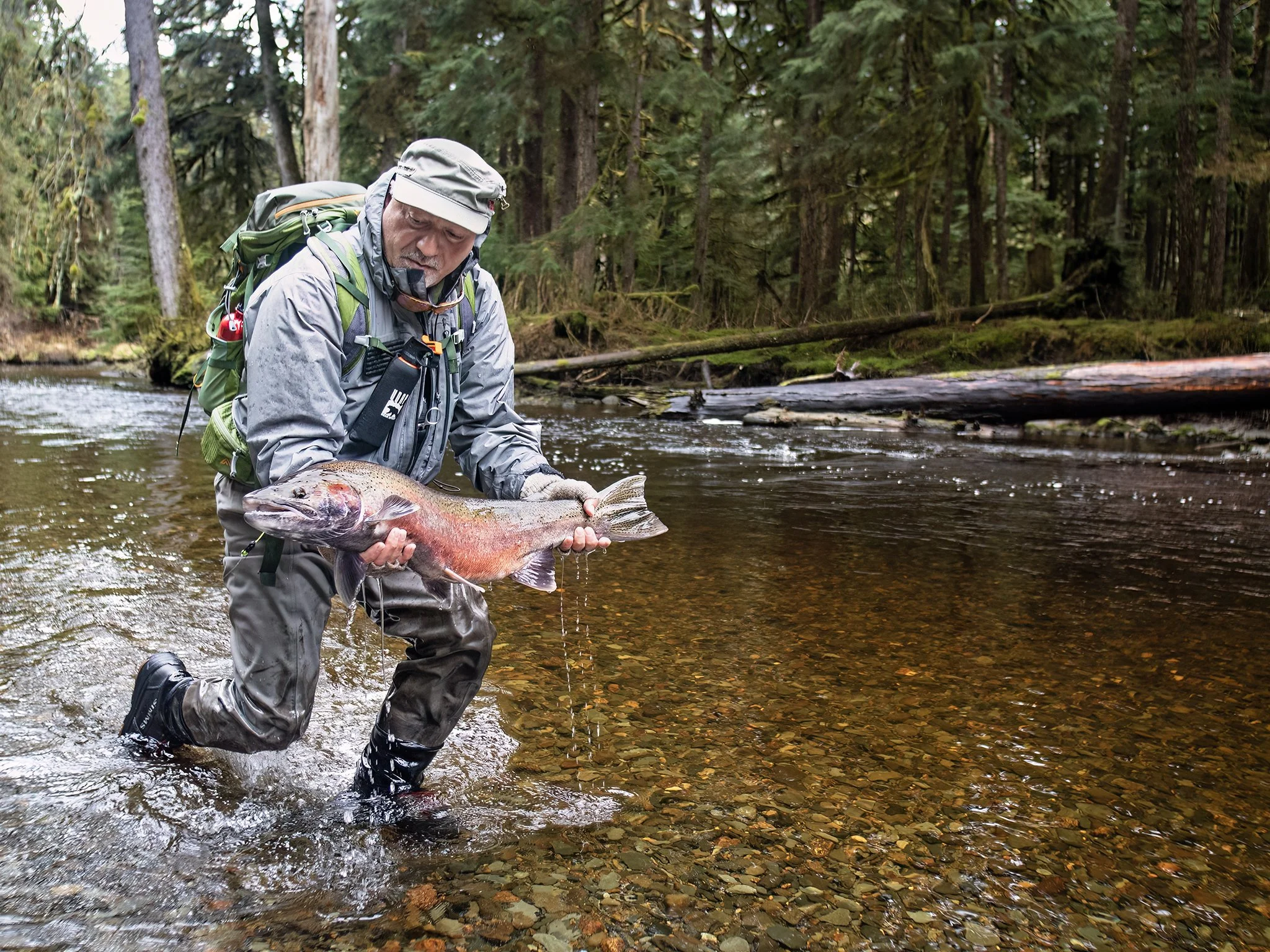
The next three days are spent exploring the smooth lower river and two or three miles of dancing, hemlock-lined upper section. Each day brings more steelhead: dark bucks to 8, 10 pounds, black-spotted and scarlet-shouldered, with hooked kypes and determined glares. There are also hens, slightly smaller, colored more like the silver raindrops that hang glittering from my ferrules. The fish aren’t particularly large as steelhead go. But of course, that’s not the point. Beyond the catching, the beauty of my time here is in having a river of steelhead entirely to myself. It’s high-yield, low-impact wilderness fishing for gems, which these days has grown all too rare.
How many Alaska steelhead streams remain yet undiscovered? I truly don’t know; perhaps not many. But I am aware of other rumors, and they are reassuring. They drive my beating heart.
Four days after setting down in the dunes, I’m standing at the window of Steve Ranney’s shack, sipping hot cocoa, examining my reflection. The sun has broken out and the clouds have lifted, revealing a massive glacier beyond my river at the foot of the jagged Coastal Range. Suddenly, a dash of iridescent emerald appears on glittering wings, hovers at collar level in the translucent reflection of my red chamois shirt. My plane is due. The hummingbird vanishes.
I’m left wondering here on the eve of my departure whether that river on the far side of the bog might one day be famous, like the Babine, the Umpqua, or Alaska’s own Situk. If so, it will be with no help from me. Through this region flow many rivers. And if, as some have claimed, the essence of fishing is to solve a mystery, or many mysteries, then finding the pristine place, like the proper steelhead fly pattern, forms the center of our purpose.
###
*NOTE: This story is adapted from a chapter in my book, “Breakfast at Trout’s Place: The Seasons of an Alaska Flyfisher.” The main theme was originally written in the early 1990s. km
IF YOU GO
Pilot Steve Ranney and wife, Wendy, own and operate Orca Adventure Lodge out of Cordova, a commercial fishing town hunkered in Prince William Sound near the western edge of Alaska’s remote Gulf Coast. Featured among his fly-outs are remote cabins overlooking wonderful fisheries for steelhead, resident rainbow trout, and salmon. To learn more, check out the webpage at http://www.orcaadventurelodge.com
Another Cordova-based air taxi I’ve used with great satisfaction is Ridgeline Aviation. Veteran Prince William Sound and Gulf Coast pilot Steve Richards is an absolute professional who will go to all reasonable lengths to get anglers to and from the Gulf Coast’s wildest fishing destinations. See more information about his operation at https://www.flyridgeline.com
Cordova is serviced by Alaska Airlines and can be reached from Anchorage or Seattle.
When planning a fly-out trip along Alaska’s Gulf Coast, consider how tides may affect drop-off and pickup times and dates. Seaplane pilots may need to schedule drop-offs and pickups for high tides, while wheel-plane operators landing on beaches may require low tides. Area tide charts are available online; discuss pickup and drop-off scheduling with your pilot or charter operator as arrangements are being made.
Alaska’s Gulf Coast is no-nonsense wilderness. It comes with brown bears and wolves; wet, windy, often raw weather; and no guarantees of immediate rescue should anglers get into trouble. Play it safe: Travel, explore, and fish with at least one partner. Bring an active satellite communicator device along the lines of a Garmin inReach to be used in case of emergency. Also, fickle weather can delay drop-off and pickup times. While hotels and lodges are available in Cordova should weather delay drop-offs, anglers in the wilderness are on their own should pick-ups be stalled. Always bring enough food to last for a few extra days.
Anglers are advised to carry bear protection, whether firearm or pepper spray. Bear spray is not allowed on Alaska Airlines flights. Talk with your air taxi pilot to see if bear spray purchased in Cordova can be accommodated (typically, bear spray cannisters will be stowed in the pontoons of air taxi float planes for safety as you travel). For valuable information concerning bear safety in Alaska, visit the Alaska Department of Fish and Game’s webpage at https://www.adfg.alaska.gov/index.cfm?adfg=livingwithbears.bearcountry
When the sun shines, few places on our planet rival the Gulf Coast’s scenic beauty. But don’t count on sunshine in this notoriously damp region. Dress appropriately for wet, windy weather. For fishing, I prefer Gore Tex chest waders to hip boots. Outside my waders, I wear fly-fishing vest and, over that, a rain jacket. Hand warmers can be lifesavers on early spring and late-fall expeditions.